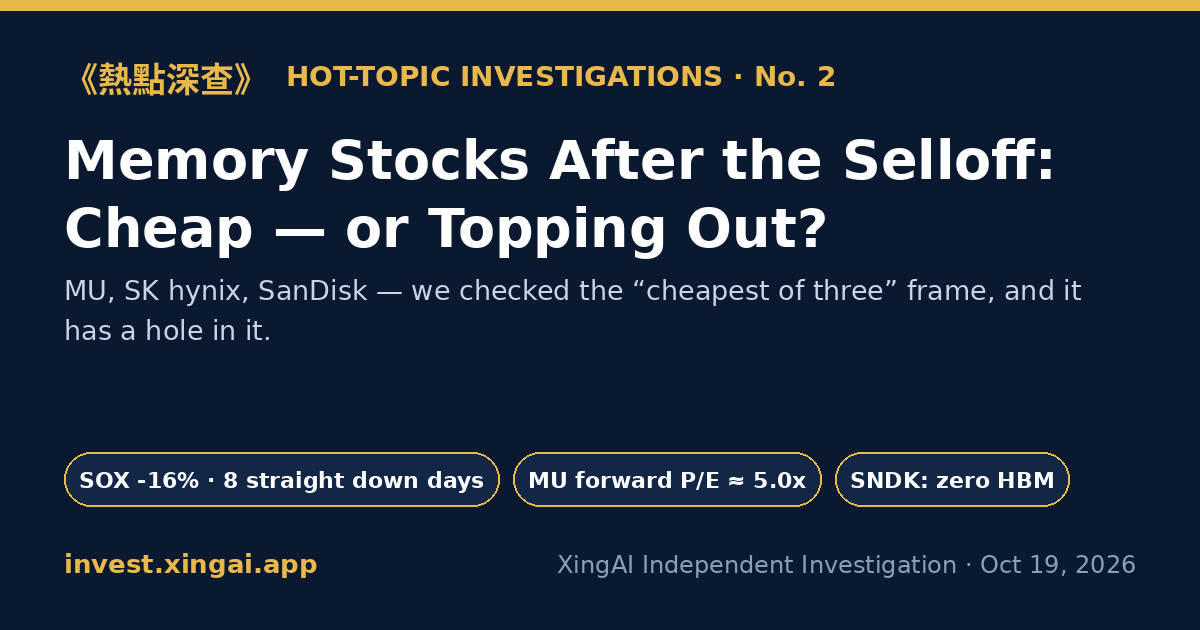
Memory Stocks After the Drop: Cheaper, or Topped Out?
Independent investigation · Published October 19, 2026 · Prices as of the Friday, October 16, 2026 close
A widely watched video this week asked which of Micron (MU), SK hynix and SanDisk (SNDK) is cheapest after a “16% semiconductor plunge”. Micron sits in our own research portfolio, so we did not borrow the video's answer — or its numbers: its in-video comparison figures were not available to us in checkable form, and we do not use what we cannot check. We verified what can be publicly verified: the index move, the three prices and multiples, the HBM exposure table, Micron's own results and guidance, and the cause of the fall. Our conclusion differs from the video's framing in three places, set out below.
XingAI Hot-Topic Investigations No. 2 — we checked the “cheapest of three” frame. Data as of Oct 16, 2026 close.
What happened, in our own verified version
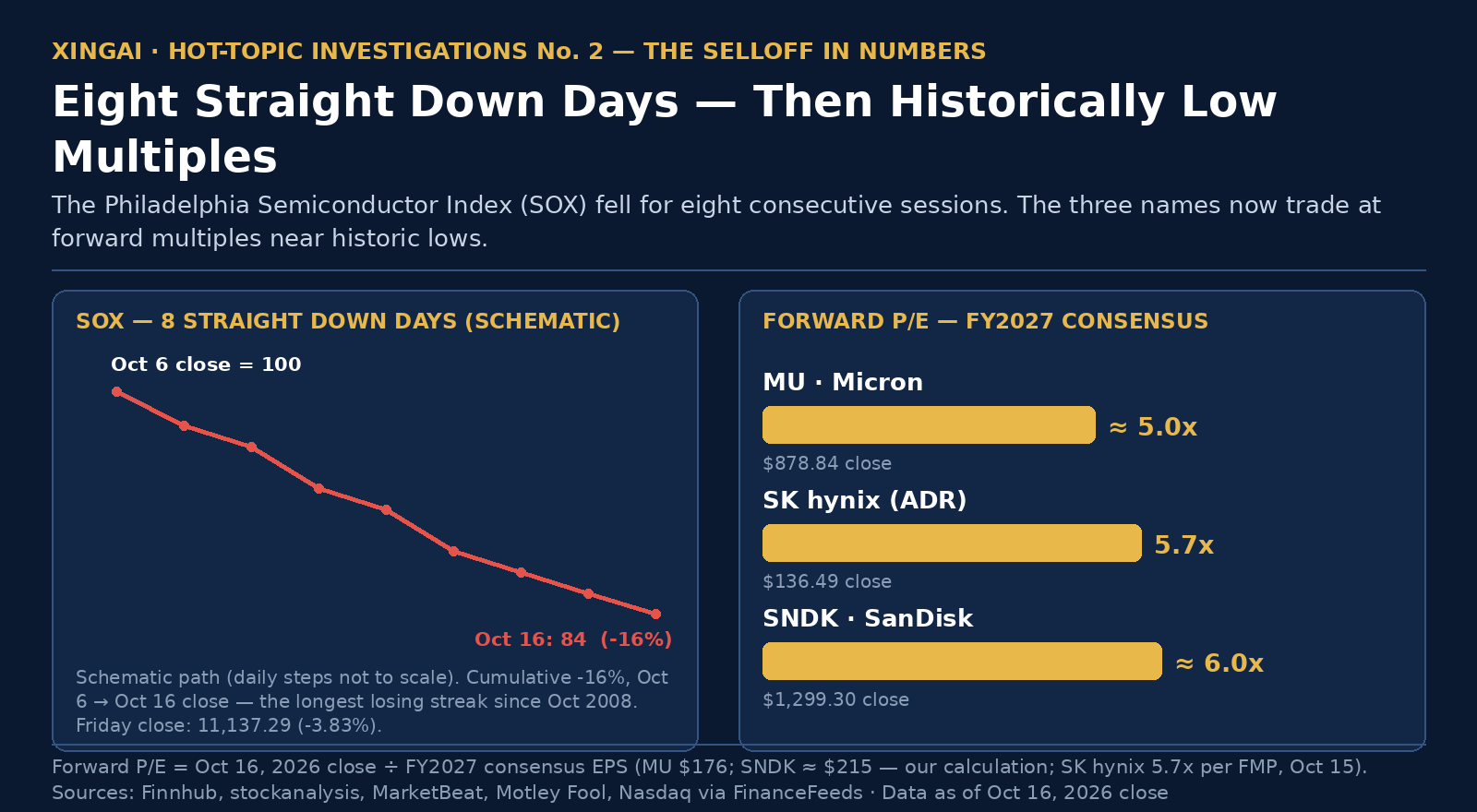
Between the October 6 close and the October 16 close, the Philadelphia Semiconductor Index (SOX) fell for eight straight sessions, losing about 16% — its longest losing streak since October 2008. The memory names fell harder than the index, but not for one single reason:
Micron (MU) fell 14.6% over five sessions to $878.84; SanDisk (SNDK) fell 17.9% to $1,299.30; SK hynix's US-listed ADR (SKHY) fell 19.25% to $136.49 (October 16 closes; Finnhub five-day returns, cross-checked against a second provider for each name).
The main trigger for memory was a supply story, not a demand break: on October 9-10, China's CXMT said it would launch server DDR5 built on a 4F² architecture by year-end. The announcement carried no speed, capacity, process-node, yield or customer-qualification data.
A second, independent chain amplified the move late in the week: the AI financing-chain de-levering around CoreWeave (our separate investigation, published today) hit crowded semiconductor positions into Friday, when all 30 SOX components fell.
On the demand side, nothing first-hand pointed down: TrendForce still expects Q4 2026 DRAM contract prices to rise 10-15% quarter on quarter (15-20% including HBM) and NAND contract prices 15-20%, and Micron's latest guidance — given on September 30 — was raised, not cut.
The claims, checked one by one
We decomposed the circulating story into five checkable claims. Verdicts: Confirmed means the evidence supports the claim as stated; Confirmed (scope corrected) means the figure is real but was framed as a different kind of statement; Partially confirmed means the direction holds but the number, scope or attribution does not.
#
Claim
Verdict
Basis in one line
1
“The SOX plunged 16%”
Confirmed — with the window stated correctly
Eight straight down sessions from the October 6 close to the October 16 close (-16%; -15.7% on a second tally) — an eight-session window, not a single week
2
“The three stocks' current prices and valuation multiples”
Prices confirmed; multiples recomputed on one stated basis — conclusions with care
October 16 closes cross-checked on two providers per name; forward multiples computed from the stated FY2027 consensus EPS for each name
3
“The three stocks' HBM exposure”
Confirmed — and it is why the three cannot be priced against each other directly
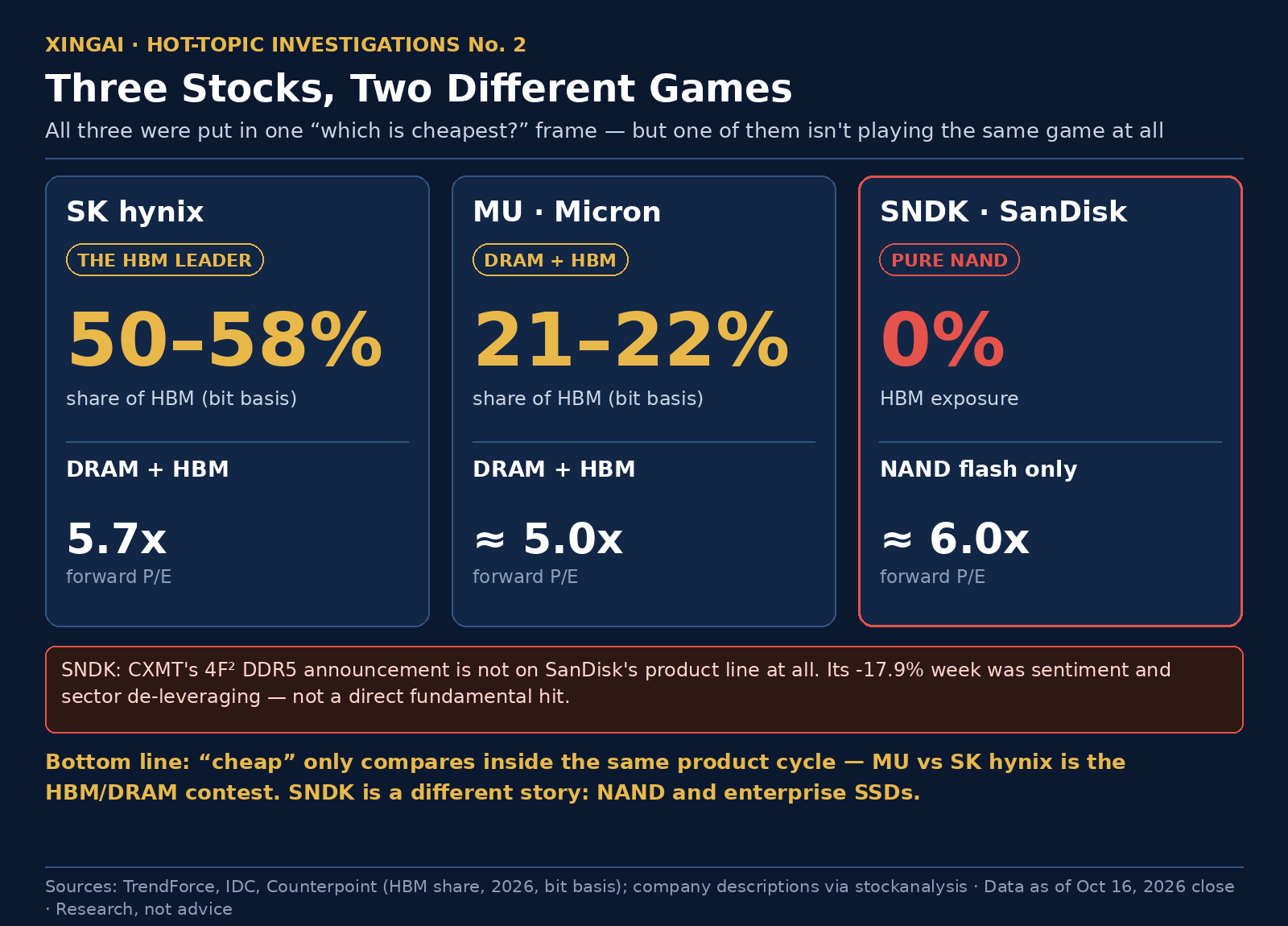
SK hynix holds roughly half the HBM market and Micron about a fifth — and SanDisk's HBM exposure is zero: it is a pure NAND company
4
“Micron's latest results and guidance”
Confirmed — from the company's own release and call
Fiscal Q4 revenue $54.23B and non-GAAP EPS $33.42 beat consensus; FQ1 FY2027 guidance was set at $61.5B of revenue and $38.15 of EPS
5
“What actually caused the fall”
Confirmed — two independent chains: CXMT is memory's trigger, the financing chain is the amplifier
CXMT's 4F² announcement (Oct 9-10) started memory's slide on Oct 12-13; CoreWeave-chain de-levering (Oct 13-16) amplified it — and the CXMT evidence is still at conference-speech grade
1. “The SOX plunged 16%”
Confirmed — with the window stated correctly
Investing.com (via Yahoo Finance, Oct 17): from the last up day on October 6, the SOX fell 16% over eight trading days — the longest losing streak since October 2008. The Trading Report (Oct 17) measured -15.7% from the October 6 close over the same eight sessions, with S3 Partners estimating about $32B of short-side paper profits in seven days.
Nasdaq's own figures (via FinanceFeeds, Oct 16): the SOX closed Friday at 11,137.29, down 3.83% on the day — its eighth consecutive lower close.
So the 16% is real, but the window is October 6 close to October 16 close across eight sessions. Calling it a one-week drop misplaces where the fall started — and, as claim 5 shows, the start date matters for attribution.
2. “The three stocks' current prices and valuation multiples”
Prices confirmed; multiples recomputed on one stated basis — conclusions with care
Closes (Friday, October 16, 2026): MU $878.84 (Finnhub and stockanalysis.com agree), five-day return -14.59%; SNDK $1,299.30, five-day return -17.86%; SK hynix ADR (SKHY) $136.49 (MarketBeat and Finnhub agree), five-day return -19.25%. On a like-for-like close-to-close window (October 9 to October 16), MU went from $1,029.00 to $878.84 (-14.6%, AIStockWire) and SNDK from $1,581.82 to $1,299.30 (-17.9%, MarketBeat daily closes).
On multiples, the three names are comparable on one basis only: forward earnings. Using FY2027 consensus EPS of about $176 for MU (Motley Fool / stockanalysis.com), MU's forward P/E at Friday's close is about 5.0x; using FY2027 consensus EPS of about $215 for SNDK (Motley Fool), SNDK's is about 6.0x; SK hynix's forward multiple is 5.7x (FMP data via Motley Fool, October 15). Trailing multiples are MU 11.8x (TTM EPS $74.33) and SNDK 17.6x (TTM EPS $73.76), per stockanalysis.com.
One figure we deliberately do not use: SK hynix's trailing P/E prints at 6.4x on Finnhub and 10.8x on MarketBeat. Data providers disagree on the basis, so the comparison on this page uses forward multiples only (see the not-used list below).
Stock
Oct 16 close
5-day return
Forward P/E (basis)
Off 52-week high
MU — Micron
$878.84
-14.59%
≈5.0x (FY2027E EPS $176)
-30.0% (from $1,255.00)
SNDK — SanDisk
$1,299.30
-17.86%
≈6.0x (FY2027E EPS ≈$215)
-44.8% (from $2,354.39)
SKHY — SK hynix (ADR)
$136.49
-19.25%
5.7x (FMP, Oct 15)
-31.7% (from $199.87)
3. “The three stocks' HBM exposure”
Confirmed — and it is why the three cannot be priced against each other directly
HBM share for 2026, bit basis: SK hynix about 50-58% (TrendForce about 50%; Counterpoint's HBM4 tally 54%; IDC and Q1 composites 56.4-58%) — the clear leader, with HBM4 in mass-production shipment since Q2. Micron holds about 21-22% (TrendForce 22%; IDC 21%) — third, but growing fastest, with HBM4 already in early mass production. Samsung, outside this trio, holds about 21-28% (TrendForce 28%).
SanDisk's HBM share is 0%. It is a pure NAND flash company with no HBM product line; its business description is NAND flash (stockanalysis.com). For scale, overall DRAM revenue share for Q2 2026 (TrendForce): Samsung 39.4%, SK hynix 24.9%, Micron 23.3%, CXMT roughly 9.5-10%.
This is the point the popular three-way comparison misses. CXMT's 4F² DDR5 announcement is not even on SanDisk's product map; SNDK's -17.9% week was sentiment follow-through and sector de-levering, not a direct fundamental hit. A “which is cheapest” frame that places a NAND company inside an HBM comparison has the wrong frame before it reaches the numbers — cheap comparisons only mean something inside the same product cycle.
Company
HBM share, 2026 (bit basis)
What it means
SK hynix
≈50-58%
The HBM leader; HBM4 shipping in volume since Q2
Samsung (reference)
≈21-28%
Outside the trio; shown for scale
Micron
≈21-22%
Third, growing fastest; HBM4 in early mass production
SanDisk
0%
Pure NAND — no HBM product line at all
Why the three-way comparison breaks: only two of the three are in the HBM game. HBM share: TrendForce / IDC / Counterpoint, 2026, bit basis.
4. “Micron's latest results and guidance”
Confirmed — from the company's own release and call
Micron reported fiscal Q4 (ended September 3, a 14-week quarter) on September 30: revenue $54.23B (+379% year on year) and non-GAAP EPS $33.42, above the $31.61-31.77 consensus (two sources); GAAP net income was $37.70B.
Guidance for FQ1 FY2027: revenue $61.5B ± $1.5B, non-GAAP EPS $38.15 ± $1.00, non-GAAP gross margin of about 86.25% (earnings release and call; dpa-AFX and SignalStack agree). The one blemish: the 86.25% gross-margin guide sat slightly below expectations — CFO Mark Murphy called it the low point of the fiscal year, with improvement after (HTX Insights).
On HBM, the company did not disclose a dollar figure, but said HBM revenue is growing faster than the company overall, that most of calendar-2027 HBM bit supply is already contracted, and — in the CEO's words — next year's volumes come at prices “far above 2026”. Data-centre revenue reached $18.0B in Q4 (33% of the total, at a 90% gross margin).
On lock-in: 26 multi-year strategic agreements carrying $32B of customer financial commitments (mostly cash deposits), remaining performance obligations of about $150B, and more than 75% of FY2027 shipments already committed. The CEO said 2027 and 2028 supply-demand will be tighter than 2026. The dividend is $0.15 per quarter, and the buyback authorisation was raised to $35.16B (from December 9, subject to the CHIPS Act direct-funding agreement).
5. “What actually caused the fall”
Confirmed — two independent chains: CXMT is memory's trigger, the financing chain is the amplifier
The trigger: at a Shanghai integrated-circuit and chiplet conference on October 9-10, CXMT president Cao Kanyu said the company would launch server DDR5 RDIMM built on a 4F² architecture before year-end; SCMP reported it widely on October 12. What the announcement did not include: no speed, no capacity, no process node, no yield, no customer-qualification status (BitPress and PBXScience both note this). CXMT's 300-plus patent families are a fact — but patents are not mass production.
The reaction timeline: Monday, October 12 — MU -3.8% and SNDK -5.9% (Wall Street Pit / CNBC intraday); Tuesday, October 13 — SK hynix -10.09% to ₩1,443,000 and Samsung -7.39% in Seoul (CNBC); a Monday post by Elon Musk on X amplified the sentiment (Invezz).
The competitive reality check: Samsung's own 4F² mass production is dated around 2028 by multiple trade outlets; SK hynix disclosed a 4F² roadmap in 2025 with no mass-production commitment; a Shanghai Jiao Tong University researcher (Tian Feng) assesses that none of the three is in large-scale commercial use — this is an emerging race, not a decided one. CXMT's Q2 2026 DRAM revenue share is already about 9.5-10% (TrendForce), but its IPO prospectus discloses no HBM production line, and Citi assesses its process as generations behind the leaders, with mass production unlikely before 2028.
The amplifier: over October 13-16 the AI financing chain de-levered — CoreWeave fell 25% on the week, its bond yields went through 16%, and hedge-fund net exposure was cut to the 30th percentile of five years (our CoreWeave investigation, published today, carries the verified detail) — and memory names were sold again inside the same crowded-position unwind; on Friday all 30 SOX components fell. Motley Fool and Invezz both name CXMT, not CoreWeave, as the main driver of Micron's slide: the two chains are independent, and the timing (memory started falling October 12-13; the credit event fermented October 14-16) shows which is primary.
The demand side, which any “top” call has to answer: TrendForce (Sep 30) expects Q4 2026 conventional DRAM contract prices +10-15% quarter on quarter, overall DRAM including HBM +15-20%, and NAND +15-20% — a slower rate of increase than Q3 (DRAM +13-18%, NAND +10-15%), but still an increase. TrendForce (Sep 29) expects 2027 HBM prices to roughly double, and Micron's call pointed to the big HBM step-up at the 2027 annual contract resets. SK hynix (Q2 call, Jul 29) has completed multi-year agreements with about 10 customers (typically five-year terms, with purchase commitments and deposits), says 2027 HBM volume and price negotiations are progressing well, and has shipped HBM4 in mass production since Q2 at yields near mature HBM3E. Enterprise SSD bit demand is expected to grow about 80% in 2026, and Samsung and SK hynix inventories sit below 10 days of supply.
On valuation digestion: from their 52-week highs, MU is -30.0%, SNDK -44.8% and the SK hynix ADR -31.7%; forward multiples on FY2027 consensus sit at about MU 5.0x, SK hynix 5.7x and SNDK 6.0x — historically very low territory (one tally puts Micron's forward multiple at 4.3x against a historical mean of 8.2x). Analysts have been raising, not cutting: Micron's FY2027 EPS consensus moved from $117.86 to $156.53 within 90 days; 53 of 58 analysts rate MU buy or strong buy; consensus targets stand at $2,173 for SNDK (+67% from Friday's close) and $253.22 for the SK hynix ADR. “Cheaper” is true at the price level — it describes the multiple, not the risk.
What we checked and are not using
The starting video's own in-video comparison figures and its “which is cheapest” conclusion: we could not obtain the figures in checkable form, so we neither reproduce nor rely on them. Every multiple on this page is recomputed from the stated consensus EPS figures above.
The claim circulating this week that “Morgan Stanley tracks $14.1B of data-center project bonds dependent on CoreWeave rent, about 30% of its tracked total”: no Morgan Stanley original could be found (see our CoreWeave investigation). Not used.
Any single trailing P/E for SK hynix: Finnhub prints 6.4x and MarketBeat prints 10.8x. The bases disagree, so this page compares on forward multiples only.
Any claim that CXMT is already mass-producing 4F² DRAM: the announcement is a year-end target for a product launch, with no published speed, capacity, yield or qualification evidence. It is not treated as a product anywhere on this page.
The question that matters to us: does “cheaper” hold for Micron?
Micron is in our research portfolio for an industry-conviction reason (see our Why I Own It series): the US memory champion, technically at the front, into structurally rising AI memory demand. We answer the “cheaper or topped out” question in three layers — price, earnings expectations, supply. Research positioning only; nothing here is a buy or sell call.
Layer 1 — Price: cheaper is a fact, and it is all it is
Five sessions: -14.6%. From the 52-week high: -30.0%. The forward P/E is about 5.0x on FY2027 consensus EPS of $176, against a historical forward-multiple mean of about 8.2x — the market is currently paying a little over half of its usual multiple for Micron's earnings. That is the entire content of the word “cheap”, and also its boundary.
Eight straight down days (schematic; daily steps not to scale), then multiples near historic lows. Forward P/E = Oct 16 close ÷ FY2027 consensus EPS — our calculation; SK hynix per FMP.
Layer 2 — Earnings expectations: nothing this week overturned them
The quarter just printed beat expectations (revenue $54.23B, non-GAAP EPS $33.42) and the next quarter's guide went up ($61.5B of revenue, $38.15 of EPS). More than 75% of FY2027 shipments are already committed, 26 multi-year agreements carry $32B of customer financial commitments, Q4 contract prices are still rising, and most of calendar-2027 HBM supply is contracted at prices “far above 2026”. The verification points are the Q4 contract-price settlements and the next earnings report on December 15 — as of today, guidance has not moved.
Layer 3 — Supply: CXMT is a real variable, still at “speech” grade
The bear case deserves precision: CXMT's share has genuinely reached about 9.5-10%, its G5 platform entered mass production in September and LPDDR6 in August — it is climbing, and if 4F² truly reached production by year-end it would be an architectural generation gap. The buffers: (1) CXMT has no HBM line — it has not yet entered the AI-memory arena; (2) the announcement lacks speed, capacity, yield and qualification data, and server RDIMM qualification cycles run in years; (3) Samsung's own 4F² timeline is around 2028 — the industry consensus is still “an emerging race”; (4) Citi estimates that HBM capacity per AI system will rise by about 434% (from 20.7TB to 110.6TB, as the number of GPUs per system grows from 72 to 576), and notes each HBM gigabyte consumes 3-4x the wafer capacity of conventional DRAM — structurally limiting oversupply; (5) new-capacity timing is fixed and late: Micron's Singapore fab in early 2027, Idaho in mid-2027, SK hynix's Yongin fab in February 2027 — no large supply-side variable lands before 2028.
Our three-layer conclusion
“Cheaper” holds at the price layer. At the earnings layer, expectations were not overturned by anything this week, but they need the Q4 contract-price settlements and the December 15 print to keep verifying. At the supply layer, CXMT is the real variable to watch over the next 12-24 months — but today's evidence is a conference announcement, not a product, and it is not enough to rewrite the company's “2027-28 supply stays tight” position. In the framework from our CoreWeave investigation (credit unmoved, guidance not cut, orders locked), Micron classifies as “hit by a different chain”, not “expectations weakening”. For reference: when memory cycles genuinely turned (2018-19, 2022-23), the leading signals were contract prices rolling over and inventories piling up. Today contract prices are still rising and inventories sit below 10 days of supply.
The three cannot be priced against each other directly. SanDisk is pure NAND with zero HBM; CXMT's DDR5 announcement is not on its product map, and its -17.9% week was sentiment follow-through. “Cheap” comparisons only mean something inside the same product cycle (Micron vs SK hynix on the HBM/DRAM line); SanDisk is a different story — NAND plus enterprise SSD.
The attribution. Memory's main trigger was the CXMT supply narrative; the CoreWeave financing chain was the amplifier. The two chains are independent — the same conclusion as this morning's CoreWeave investigation.
The “-16%” scope. It is an eight-session window (October 6 close to October 16 close), not one week — and memory's start down (the CXMT reaction on October 12-13) precedes the CoreWeave credit event's fermentation (October 14-16). The time order itself shows which is primary.
Our judgment, in one paragraph
Nothing first-hand this week showed AI memory demand weakening; the evidence points to a slower rate of price increases, not a turn. Micron got cheaper on price while its earnings anchors held — in our framework that is “caught in another chain's wash”, not a cycle top being confirmed. The genuine variable is CXMT's supply climb over the next 12-24 months, and it will be settled by product evidence — specifications, yields, qualifications — not by conference announcements.
What we are watching next
SanDisk earnings, October 29 (FY2027 Q1): NAND realised pricing, enterprise customer mix, and whether gross margin holds the 83-85% guidance
SK hynix Q3 earnings (about October 29): 2027 HBM negotiation progress, ASP pass-through, Yongin fab progress
Final Q4 DRAM and NAND contract-price settlements (TrendForce basis: DRAM +10-15%, NAND +15-20% — do they land?)
Whether CXMT publishes 4F² sample specifications — speed, capacity, customer qualification — the only path from “speech” to “product”
Micron's next earnings, December 15: is FY2027 guidance maintained, and is the contracted HBM pricing being realised?
The October 28 FOMC meeting — rates were this round's financing-chain trigger and are also its release condition (see our CoreWeave investigation)
How we check our numbers
Every figure on this page comes from our own investigation, published October 19, 2026, with prices as of the Friday, October 16, 2026 close. Before publication, each figure was checked against at least two independent sources. Where sources disagreed, we followed the primary source — company filings and releases, exchange data and official statistics; where no primary figure could be obtained, we dropped the number rather than estimate it. Every valuation multiple on this page is recomputed by us from the consensus EPS figures stated next to it; we did not borrow the starting video's comparison figures, which were not available in checkable form. Figures we checked but refused to use are listed openly at the end of this page, with the reason for each refusal.
Sources
Every figure on this page comes from our investigation report of October 19, 2026 — each claim cross-checked against at least two sources before publication. Where two sources disagreed on a figure, we followed the primary source; where no primary figure could be obtained, the figure was dropped rather than estimated. The starting point for the claims list was a same-day market-media video; it is a list of claims to be checked, not a source, and it is not cited as evidence anywhere on this page. Its in-video comparison figures were not obtainable in checkable form and are not used.
Investing.com (via Yahoo Finance, Oct 17, 2026) — the SOX fell 16% over eight trading days from the last up day on October 6, its longest losing streak since October 2008 newsbeep.com
The Trading Report (Oct 17, 2026) — the SOX down 15.7% from the October 6 close over eight sessions; S3 Partners estimates about $32B of short-side paper profits in seven days thetradingreport.com
FinanceFeeds (Oct 17, 2026) — Nasdaq official figures: the SOX closed Friday, October 16 at 11,137.29, down 3.83% on the day, an eighth consecutive lower close financefeeds.com
Finnhub market data — five-day returns and closes: MU -14.59% / $878.84, SNDK -17.86% / $1,299.30, SKHY (ADR) -19.25% / $136.49, 000660.KS -20.44%; AIStockWire (Oct 17, 2026) close-to-close check: MU $1,029.00 (Oct 9) to $878.84 (Oct 16) MU · SNDK · SKHY · aistockwire.com
stockanalysis.com — MU close $878.84, trailing P/E 11.82, forward P/E 4.98 on its basis; SNDK close $1,299.30, forward P/E 6.05 on its basis; fiscal-2026 figures MU · SNDK
MarketBeat — SKHY closed October 16 at $136.49; 52-week range $124.80-$199.87; consensus target $253.22 marketbeat.com
Motley Fool (Oct 17 and Oct 12, 2026) — MU forward P/E of about 5x on FY2027 consensus EPS of $176; SNDK FY2027 consensus EPS of about $215 (a forward multiple of about 6.0x at Friday's close) MU · SNDK
Motley Fool / FMP (Oct 15, 2026) — SK hynix forward P/E of 5.7x fool.com
TrendForce (via Gate blog) — 2026 HBM bit share: SK hynix about 50%, Samsung 28%, Micron 22% gate.com
TrendForce Q2 2026 DRAM revenue (via C114Pro and TechTimes) — Samsung 39.4%, SK hynix 24.9%, Micron 23.3%; CXMT at about 9.5-10% (via StockWireX) c114pro.com · stockwirex.com
SignalStack (Oct 2, 2026) — Micron fiscal Q4: revenue $54.23B, GAAP net income $37.70B; FQ1 FY2027 guidance: revenue $61.5B ± $1.5B, non-GAAP gross margin 86.25%, non-GAAP EPS $38.15 ± $1.00; 26 strategic agreements, $32B of commitments, remaining performance obligations of about $150B signalstack.news
dpa-AFX via TradingView (Sep 30, 2026) — Micron Q4: GAAP net income $37.701B, non-GAAP EPS $33.42, revenue $54.229B tradingview.com
ad-hoc-news (Oct 5, 2026) — Micron's September 30 print against consensus (EPS $33.42 vs $31.61, revenue $54.23B vs $51.07B, per CNBC); MarketBeat consensus target $1,375.58; Rosenblatt target $1,900 ad-hoc-news.de
HTX Insights (Oct 1, 2026) — Micron data-centre Q4 revenue $18.002B (+56% quarter on quarter, 33% of the total, 90% gross margin); most of calendar-2027 HBM supply already contracted, at prices far above 2026; CEO: 2027-28 supply-demand tighter than 2026 htx.com
EquitySwarm (Oct 12, 2026) — more than 75% of Micron's FY2027 shipments already committed, with discussions extending into 2028; Q4 operating cash flow $43.97B equityswarm.com
BitPress (Oct 14, 2026) — CXMT's October 9-10 Shanghai announcement and SCMP's October 12 coverage; October 13: SK hynix -10.09% to ₩1,443,000, Samsung -7.39%; the announcement disclosed no speed or capacity figures bitpress.kr
AsiaDaily (Oct 12, 2026) — CXMT milestone timeline: 4F² research since 2016, G5 platform into mass production in September, LPDDR6 in August, the October 10 Shanghai launch, a year-end server DDR5 RDIMM target; Samsung's 4F² mass production around 2028 asiadaily.org
PBXScience (Oct 16, 2026) — CXMT's announcement disclosed no speed, capacity, process node, yield or qualification status; 4F²'s hard problem is yield pbxscience.com
StockScalping forum (Oct 12, 2026) — the October 12 US reaction: MU -3.8%, SNDK -5.9% (CNBC intraday); CXMT's 4F² is a target, not a product, with a long qualification road ahead stockscalping.com
LiveTradingNews (Oct 14, 2026) — Elon Musk's post on X amplifying the story; the framing of commodity layers China can scale versus tool-constrained layers where it still lags livetradingnews.com
TrendForce (Sep 30, 2026, via Guru3D and SMM) — Q4 2026 contract prices: conventional DRAM +10-15% quarter on quarter, overall DRAM including HBM +15-20%, NAND +15-20% guru3d.com · metal.com
TrendForce (Oct 6, 2026) — the Q4 pricing basis restated; PC DRAM's share of capacity falls further in 2027 trendforce.com
TechDefused (Oct 1, 2026) — the HBM price step-up lands at the 2027 annual contract resets; Wedbush channel checks describe DRAM in the high double digits and NAND +10% or more in industry talks techdefused.com
The Investor (Jul 29, 2026) — SK hynix Q2: revenue ₩79.3T (+257%), operating profit ₩60.5T (+557%), gross margin 76%; about 10 long-term-agreement customers (typically five-year); 2027 HBM negotiations under way; HBM4 in mass production in Q2, HBM4E sampled; capex guidance ₩40T+; Yongin Y1 production in February 2027 theinvestor.co.kr
The Register (Jul 29, 2026) — SK hynix Q2: DRAM ASP up about 30% quarter on quarter, NAND ASP up about 50%; about 10 long-term agreements theregister.com
Wccftech (Jul 28, 2026) — SK hynix's Q2 missed consensus by 5-6% as long-term-agreement pricing slowed ASP pass-through; the CEO called 2027 the tightest supply year on record; 2026/2027 HBM supply of 18/24 billion GB wccftech.com
Substack — edbutowsky (Oct 12, 2026) — TrendForce (Sep 29): 2027 HBM prices to roughly double; SK hynix's $29B buyback (Aug 20-Nov 19, about 3% to be cancelled); Micron's FY2027 EPS consensus up from $117.86 to $156.53 within 90 days; Micron's FY2026 buyback only $650M substack.com
TechTimes / C114Pro (Sep 7, 2026) — Samsung and SK hynix inventories below 10 days of supply; the HBM4 substitution effect worsening capacity crowding by about a third techtimes.com
Corewavelabs (Oct 7, 2026) — Q3 contract prices: Bernstein's tally of DRAM near +20%, TrendForce DRAM +13-18% and NAND +10-15%; enterprise SSD bit demand expected +80% in 2026 corewavelabs.com
FinanceFeeds (Oct 17, 2026) — SanDisk: the August 5 print showed revenue $8.965B (+51%); FQ1 FY2027 guidance of revenue $10.30-10.80B and gross margin 83-85%; earnings on October 29; the June high was $2,354.39 financefeeds.com
CapitalSnitch (Oct 18, 2026) — Micron five-day -14.6% and -27.6% from its 52-week high on their tally; SanDisk -44.4% from its high; 53 of 58 analysts at buy or strong buy on Micron capitalsnitch.com
SignalPlus (Oct 18, 2026) — the SOX's eight straight falls and -16%, the longest streak since 2008; AI and semiconductor market value down more than $1T; the SOX had risen more than 60% in 2026 before this signalplus.com
Our own investigation, published today (Oct 19, 2026) — CoreWeave contagion and the AI financing chain: the memory selloff's attribution (CXMT the trigger, the financing chain the amplifier) and Micron's positioning as hit by a different chain CoreWeave investigation
TradesTie (analysis updated Oct 16, 2026) — Micron (MU): forward P/E of 4.3x on its next-year-estimate basis vs a historical average forward multiple of 8.2x (the site's own model figure; averaging window not disclosed), at the Oct 16 close of $878.84 tradestie.com
Citi research (Aug 2026), as reported by ADVFN InvestorsHub (Aug 9, 2026) and Parameter.io — total HBM capacity per AI system rises about 434%, from 20.7TB to 110.6TB, as GPU count per system grows from 72 to 576 investorshub.advfn.com · parameter.io
Checked, and not used
The starting video's own in-video comparison figures and its “which is cheapest” conclusion: we could not obtain the figures in checkable form, so we neither reproduce nor rely on them. Every multiple on this page is recomputed from the stated consensus EPS figures above.
The claim circulating this week that “Morgan Stanley tracks $14.1B of data-center project bonds dependent on CoreWeave rent, about 30% of its tracked total”: no Morgan Stanley original could be found (see our CoreWeave investigation). Not used.
Any single trailing P/E for SK hynix: Finnhub prints 6.4x and MarketBeat prints 10.8x. The bases disagree, so this page compares on forward multiples only.
Any claim that CXMT is already mass-producing 4F² DRAM: the announcement is a year-end target for a product launch, with no published speed, capacity, yield or qualification evidence. It is not treated as a product anywhere on this page.
Data as of October 19, 2026. Prices and five-day returns are as of the market close on Friday, October 16, 2026. This page is a fixed research record; it is not updated with live data.
Research and education only. This page is our own independent investigation; the views expressed are ours, and figures attributed to named institutions are summarised from the cited reports. This page is not investment advice, not a recommendation, and not a promise of returns. Read the full disclaimer before acting on anything here.